Your Community's Brand: Build It or Die!
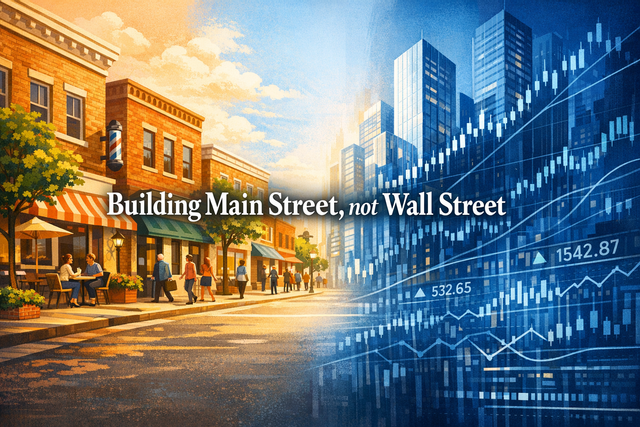
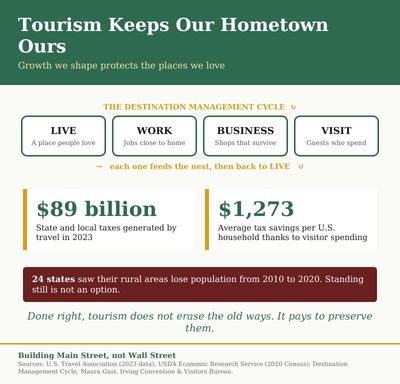
Here is a number every community leader should know: $2.9 trillion. That is the total economic output generated by the U.S. travel and tourism industry in 2024 alone, supporting more than 15 million American jobs Globally, travel and tourism now account for nearly 10 percent of the entire world economy. That money does not distribute itself equally. It flows, with precision toward communities that have given people a reason to show up. If your community hasn't built that reason, you are not just missing out on a slice of the pie. You are watching the demise of entire community.
Let's get the definition of brand right, because most communities get it wrong. A brand is not a logo. It is not a slogan dreamed up at a chamber of commerce retreat. A brand is a perception or what other people genuinely think and feel about your community before they ever arrive. It is an emotional promise, ou shape it deliberately or the world shapes it for you, usually unfavorably.
The most powerful brands do not lead with location. They lead with feeling. When someone is planning a vacation or deciding where to relocate their family, they rarely begin by searching a map. They search for an experience first; fly fishing, craft beer trails, mountain biking, farm-to-table food, art scenes, outdoor adventure, and then they search for where that experience lives. Communities that understand this truth compete. Those that don't simply hope. Consider the evidence: <30 percent of travelers say they chose a destination specifically because of a cultural or heritage attraction. The Kentucky Bourbon Trail drew 2.5 million visitors in 2023. A single, well-defined identity, bourbon heritage became an engine that moves millions of people across hundreds of miles. That is what a focused brand does.
Rural and small-town America is under siege. The 2020 U.S. Census was the first in history in which fewer people were counted in rural counties than in the prior census. Over half of the nation's counties, home to a quarter of all Americans — lost population. The industries that once anchored these communities: manufacturing, agriculture, mining, have automated, globalized, or simply vanished. Younger generations are leaving, not because they don't love where they grew up, but because they see no economic future there. This is not destiny. It is a branding failure.
The communities that are reversing these trends share one thing: a clear, compelling, authentic identity that draws people in as visitors first, then as residents and business owners. Remote work has reshuffled the deck for the first time in decades. An estimated 35 million Americans now work remotely at least part of the time. For the first time in a generation, location is negotiable for a massive and growing segment of the workforce. Skilled workers, entrepreneurs, and young families are choosing where to live based on quality of life which is another word for brand. Communities that communicate a powerful sense of place are winning this competition. Communities that cannot articulate who they are will keep losing their best people to those that can.
The failure mode is predictable: a committee forms, a consultant is hired, a focus group convenes, and after six months of deliberation, the community produces a tagline broad enough to offend no one and inspire no one. "Gateway to Adventure." "Where History Meets Tomorrow." These phrases hang on banners and accomplish nothing. Focus groups and local politics are the enemies of great community brands. Focus groups water ideas down to keep everyone comfortable. Politics kills bold ideas before they can breathe. A brand built this way is a brand built for the room it was created in, not for the visitor, the remote worker, or the business owner you need to attract.
The second failure is over promising. A brand must be grounded in reality. If your community brands itself as a culinary destination and visitors arrive to find two chain restaurants, you have not just failed to attract them — you have poisoned the well. It takes years to recover from that kind of reputational damage. Great brands are built on great products. The brand comes second.
Effective community branding starts with an honest answer to a brutal question: What does our community do better than anyone within 200 miles? Not what you wish you were known for what you have, what is authentic, what is already here in some form waiting to be amplified. That answer should be specific, not generic. "Beautiful scenery" is not a brand. "The best whitewater kayaking between Atlanta and Asheville" is a brand. Specificity creates memorability. Memorability creates search traffic. Search traffic creates visitors. Visitors create revenue.
Once you know what you are, commit to it fully. Narrow the focus. Resist the temptation to be everything to everyone, because that path leads to being nothing to anybody. The travel and tourism market is brutally competitive; there are thousands of communities competing for the same attention. Only those with a distinct, defensible identity break through the noise. Build for the long term. A brand is a 10-year project, not a 10-month campaign. Where does your community need to be in a decade? What infrastructure, what events, what experiences, what businesses does that vision require? Work backwards from that future and build toward it deliberately.
And bring in outside perspective. The people who live inside a community are often the last to see it clearly. An outside lens guided by real market research, not assumptions can identify the authentic strengths that locals take for granted and the gaps that outsiders notice immediately.
Communities that delay this work are not standing still. They are falling behind. Travel & Tourism is projected to account for 1 in 3 new jobs created globally over the coming decade. The communities positioned to capture those jobs will be the ones with clear identities, loyal visitors, and magnetic stories. The rest will keep watching their tax base erode, their down-towns hollow out, and their young people leave. A community without a brand is a book without a plot. Nobody finishes it. Nobody recommends it. Nobody comes back. The choice is not whether your community will be perceived. It will be. The only question is whether you will shape that perception with intention — or leave it to chance and watch your community slowly disappear.
John Newby, Pineville, MO., is a nationally recognized publisher, community, business and media consultant, & speaker. His column appear in communities nationwide. He is currently the CEO of the McDonald County Chamber and the founder of Truly-Local, dedicated to helping communities create excitement, energy, and capture the synergies needed to thrive in an ever increasingly complicated environment. He can be reached at [email protected].