Small Communities Die Holding Onto Yesteryear!
A good friend called me not long ago, frustrated. His town had a real shot at something big, a project that could have changed the trajectory of his downtown for a generation. Instead, it got picked apart in a back room and committee accepting the lowest bar possible until there was nothing left worth doing. I have heard versions of that same phone call more times than I can count, from more towns than I can name. The details change. The ending rarely does.
There is an old parable about a fisherman with a bucket of crabs and no lid. He does not need one. Every time a crab starts to climb out, the others reach up and pull it back down. I used to think that story was about jealousy. I have come to believe it is about something more specific. It is about people who once had the energy to climb, who got tired of trying, and who now find it easier to keep everyone else at the bottom with them.
That is the poverty mindset, and it has nothing to do with how much money is in the bank. It is a habit of thought that treats every bold idea as a risk to be managed down to nothing rather than an investment to be grown. It shows up in government, chambers, and Main Street meetings where a new idea gets nodded at politely and quietly buried. It shows up in city councils that table the proposal for further study, again, for the third year running. It is the enemy of vision, and without vision and a willingness to change, a community has no defense against decline. Of course, it is all masked in the robes of tradition, the way it was years ago, and a lack of willingness to grow with the times. We can all fall into this insidious trap.
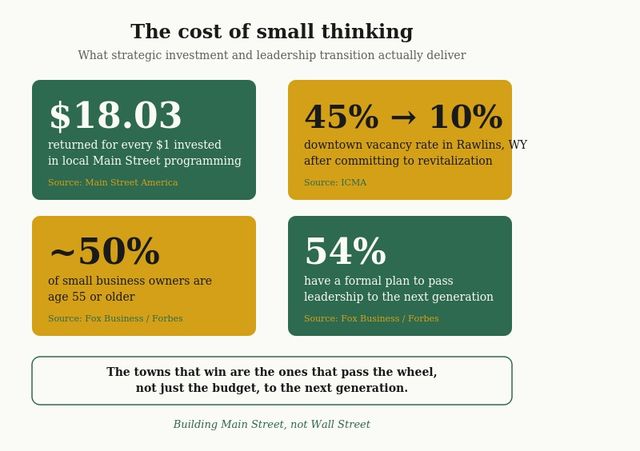
The research backs up what those of us in this work have felt for years. Communities that pursue strategic revitalization through coordinated programming have generated more than eighteen dollars in new private and public investment for every dollar spent operating the program itself. Rawlins, Wyoming, took its downtown vacancy rate from 45 percent down to 10 percent after committing to that kind of sustained, strategic investment. None of that happened by accident, and none of it happened because someone decided the safest path was also the smartest one. The safest path is rarely the best one.
Here is the harder truth I want to share, and I want to share it with respect, because I mean it that way. The biggest obstacle most small communities face right now is not a lack of money, talent, or opportunity. It is a leadership bench that is aging out and has not prepared anyone to take its place. Nearly half of small business owners in this country are 55 or older, and barely half of them have any kind of formal succession plan in place. That is not a criticism of the men and women who built these businesses and these towns with their own two hands. They earned every bit of credit they have.
But the towns that survive the next decade will be the ones that turn that hard won wisdom into mentorship rather than gatekeeping, and the ones that fade will be the ones where every new idea must clear the approval of someone who has already decided the answer is no.
I think most of the resistance is not stubbornness so much as exhaustion. Leaders who have watched grant applications get rejected and projects fall apart for years develop a perfectly understandable defense mechanism. They stop expecting things to work. The trouble is that low expectation becomes a forecast that fulfills itself, and a town cannot out organize a leadership culture that has quietly decided nothing here ever changes.
Look at your own downtown with honest eyes. Is the holdup really a lack of resources, or is it that the people steering the conversation have been steering it the same way for thirty years and have never been asked to pass the wheel to someone with new eyes? The towns thriving right now are not the lucky ones. They are the ones where longtime leaders made room at the table on purpose, brought newcomers and younger voices into real decision-making roles, and let big ideas survive contact with daylight instead of dying in committee.
Here is what you can do this week. Go to your next chamber, council, or Main Street board meeting and ask one direct question out loud: who is being groomed to lead this effort five years from now? If the honest answer is nobody, say so, kindly but clearly, and volunteer to help build that bridge yourself. Every reader in every community can do that within the next seven days, and it costs nothing but the willingness to speak up.
John A. Newby, a Chamber President, past Publisher & Media Executive, Business Owner, Consultant, and International Speaker is the author of the "Building Main Street, Not Wall Street" column dedicated to helping local communities combine their synergies allowing them to thrive in a world where truly-local is being lost to Wall Street interests. His email is [email protected]