Potential Tourism's Headaches Are Worth the Money!
On any given summer weekend, one can stand on the banks of their local stretch of river or lakes and watch a line of coolers, canoes and lawn chairs stretch further downstream than one can see. While most are well-behaved, somewhere in that crowd a deputy was breaking up an argument, a mother was hunting for a missing child, and a business owner was smiling all the way to the bank. That is tourism in a nutshell. It can be loud, it can be messy, and it is one of the best things that can happen to a small community or county.
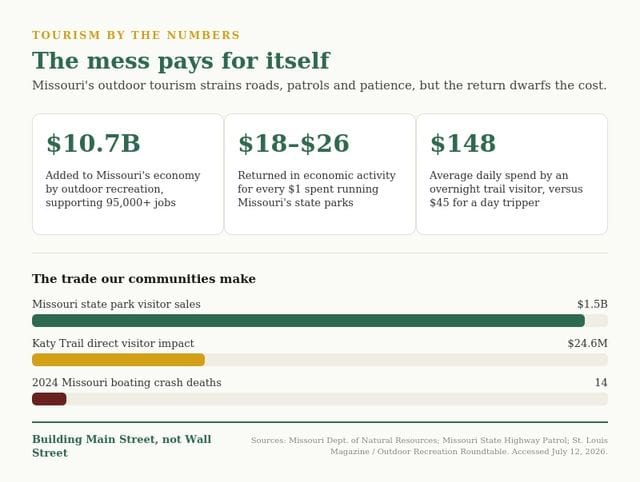
To be Fair, tourism can have drawbacks. Water sports bring real safety concerns; alcohol is involved in up to seventy percent of deaths tied to water recreation. Missouri recorded fourteen deaths and seventy-two injuries in recreational water sports alone in 2024 alone. Cycling events/rides like one’s tourism partners across the state promote can have safety concerns, slow down farm trucks, create bottlenecks along routes, and cause complaints from neighbors who just wanted to get to church on time. Add to those, exploring caves, hiking, fishing, hunting, and a host of other tourism attractions are cumbersome on local towns and infrastructure.
Traffic is the third headache, and it is the one most visible to residents who never set foot in a canoe. More cars on two lane roads means more near misses, more wear on pavement our county did not budget for, and more frustration for people whose daily errands now compete with out of state license plates or cyclists. We can learn from some larger cities that have learned this lesson the hard way. Barcelona drew nearly eleven million visitors in August of 2024 alone, and the strain on housing and neighborhoods sparked street protests under the banner "tourists go home." Amsterdam went so far as to launch a marketing campaign asking travelers to simply stay away. Those are large market cases, but they are a great example that show growth without planning creates resentment, not prosperity.
Here is where the math changes the conversation. In my home state of Missouri, outdoor tourism generated 1.7 billion dollars and supports more than 95,000 jobs each year. The Missouri park system ran on a budget of $68 million dollars; however, it returns as much as 18-24 dollars in economic activity for every dollar spent and drives roughly 1.5 billion dollars in total sales for Missouri businesses. The Katy Trail alone generated 24.6 million dollars in direct visitor spending and supported 260 jobs, with day trippers spending about $45 daily, mostly at local restaurants, and overnight guests spending closer to one $148 a day on lodging, food and gas. Academic researchers studying rural counties have found the same pattern repeats itself. Tourism policy reliably boosts per capita income, new business registration and land investment, and the environmental costs, while real, run far below the economic gains.
Yes, rural communities ask their law enforcement to work overtime. Yes, we ask farmers to be patient with slow moving traffic. Yes, we ask our road crews to repaint faded shoulder lines more often than we would like. In exchange, our cafes fill up on a Tuesday, our gas stations sell out of ice, our campgrounds book solid, and dollars that would never have found your community land in local cash registers of businesses that call this place home. River floating for a few months out of the year or a cycling event that is inconvenient for a few hours a couple times a year does not just move people through our towns, it moves their money into them.
The lesson for any rural community is not to avoid tourism because it is inconvenient. It is to manage it honestly, funding the safety patrols, the signage and the road maintenance that growth demands, while keeping our eyes on the far larger return that growth delivers. Communities that plan for the mess tend to keep the money. Communities that pretend the mess does not exist or fight the trends tend to lose both the visitors and the goodwill of their own residents.
If you live in a community that welcomes visitors, take 24 hours to do one simple thing. Call your local leaders and ask how visitor spending is being reinvested in the roads, safety services and small businesses that carry the load. Then thank a local business owner for putting up with the crowded parking lot. Rural communities growing pains are worth it, but only if we keep asking the hard questions that make sure they stay worth it.
John A. Newby, a Chamber President, past Publisher & Media Executive, Business Owner, Consultant, and International Speaker is the author of the "Building Main Street, Not Wall Street" column dedicated to helping local communities combine their synergies allowing them to thrive in a world where truly-local is being lost to Wall Street interests. His email is john@truly