AI Is Already Reshaping Rural Business Competition
Love it or hate it, AI is here and facing that reality can assist your business greatly. There are three things quietly reshaping how small businesses compete. None of this requires a computer science degree. But ignore these trends for another year and you will feel it.
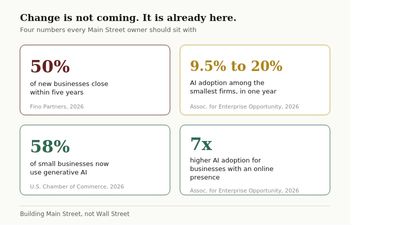
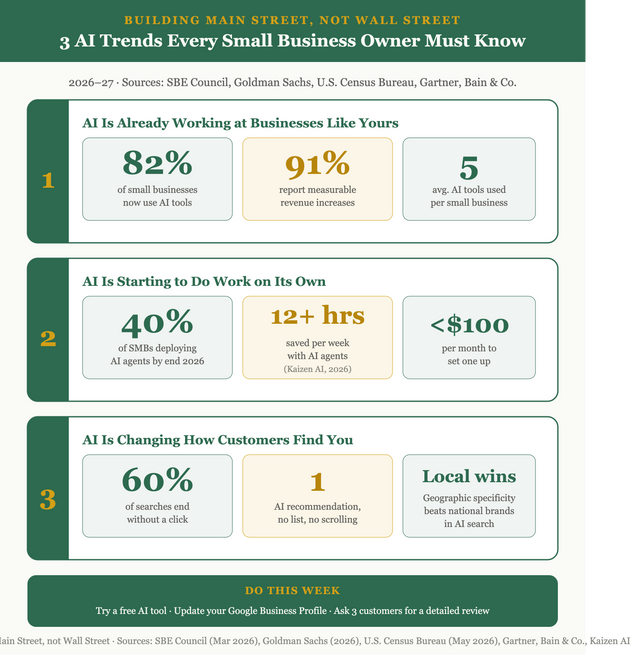
Trend One: AI is already working at businesses like yours. Here is a number that stopped me cold. According to a March 2026 survey by the Small Business and Entrepreneurship Council, 82 percent of small business employers have invested in AI tools, and the average small business is running five of them at once. Not one curious experiment. Five tools.
That same survey found 91 percent of small businesses using AI report measurable revenue increases. A Goldman Sachs survey from 2026 found 84 percent cite efficiency gains as the primary benefit. What does that look like in practice? A shop owner using a $20 per month tool to write product descriptions in minutes. A restaurant owner scheduling a week of social posts in one hour. A contractor using AI to draft estimates and follow up with leads automatically.
The U.S. Census Bureau confirmed in May 2026 that about 20 percent of American businesses are actively using AI, and another 20 to 23 percent expect to start within six months. Small businesses are closing the gap and overcoming the scale available to large companies faster than any previous technology wave. This is not about replacing people. It is about giving your small team the output of a much bigger one.
Trend Two: The newest shift is something called agentic AI. The tools you may have tried before are like a smart assistant who answers when you ask. Agentic AI is more like an assistant who watches your inbox, flags urgent messages, drafts replies, books appointments, and follows up with leads without being asked. Gartner projects 40 percent of small and mid-size businesses will deploy at least one AI agent by end of 2026, up from just 8 percent at the start of 2025. Businesses already doing this report saving 12 or more hours per week.
Consider a small accounting firm in Austin that set one up for under $100 per month. It reads incoming emails, sorts by urgency, drafts responses to routine questions, and creates follow-up tasks. The owner got her Sundays back. The biggest wins come from narrow tasks: answering the same five customer questions every day, booking appointments, sending invoice reminders. Not flashy, but exactly the repetitive work that drains an owner's week. No-code platforms have put these tools within reach of any owner willing to spend a few hours getting started.
Trend Three: This one may matter most, and it is the one fewest Main Street owners have heard about. When someone searched "best hardware store near me" a few years ago, Google showed a list of links. Today, AI-powered tools including Google's AI Mode, ChatGPT Search, and Perplexity increasingly answer that question directly. They pick a business, describe it, and point the customer there. No list. No scrolling. One recommendation. Bain and Company research found that nearly 60 percent of searches now end without a click because the AI answered right on screen. Your website might rank well and still get passed over.
The businesses AI recommends are the ones keeping their Google Business Profile complete, collecting detailed reviews, and answering common questions in plain language on their websites. This used to be called good SEO. Now it is the difference between being picked or being invisible. Local businesses have a real advantage here. AI search favors geographic specificity. A shop that owns the phrase "best florist in Galena, Illinois" has a head start no national chain can take away.
Here are three things you can do this week. First, spend 30 minutes with a free AI tool like ChatGPT or Claude and ask it to write something you normally spend an hour on: a social post, a follow-up email, a product description. Notice how much time it saves. Then ask what else it could handle. Second, log in to your Google Business Profile at business.google.com and fill in every field. Add your hours, services, a few photos, and a description of who you serve. This is the single most important step you can take right now to appear in AI search results. Third, ask your three best customers to leave a detailed Google review this week. Not just five stars, but a few sentences about what you do and who you help. AI tools treat those reviews as evidence of your expertise, and the more specific, the better.
AI is not coming for Main Street. It is already here, and the businesses taking small steps now are the ones who will not have to scramble later.
John A. Newby, a Chamber President, past Publisher & Media Executive, Business Owner, Consultant, and International Speaker is the author of the "Building Main Street, Not Wall Street" column dedicated to helping local communities combine their synergies allowing them to thrive in a world where truly-local is being lost to Wall Street interests. His email is [email protected]