Data Centers Deserve Facts, Not Fear
Most conversations I have had about data centers follows the same script. Someone comments on social media or raises a hand at a planning meeting warning about water being stolen, power grids collapsing, and companies strip-mining rural land. People nod; fear spreads and ignorance grow. A facility that can bring economic benefit to a struggling town gets voted down on the back of misinformation disguised as civic concern.
Before the fear takes hold, let me ask you something. Did you check your bank balance this morning? Stream a show last night? Back up your phone photos? Pay a bill online? All those actions ran through a data center. This is not some strange new technology being dropped on rural America from above. It is the same infrastructure you have depended on for decades, simply growing to keep pace with the world we already live in.
So let's take an honest look at data centers: the good, the bad, and the genuinely complicated.
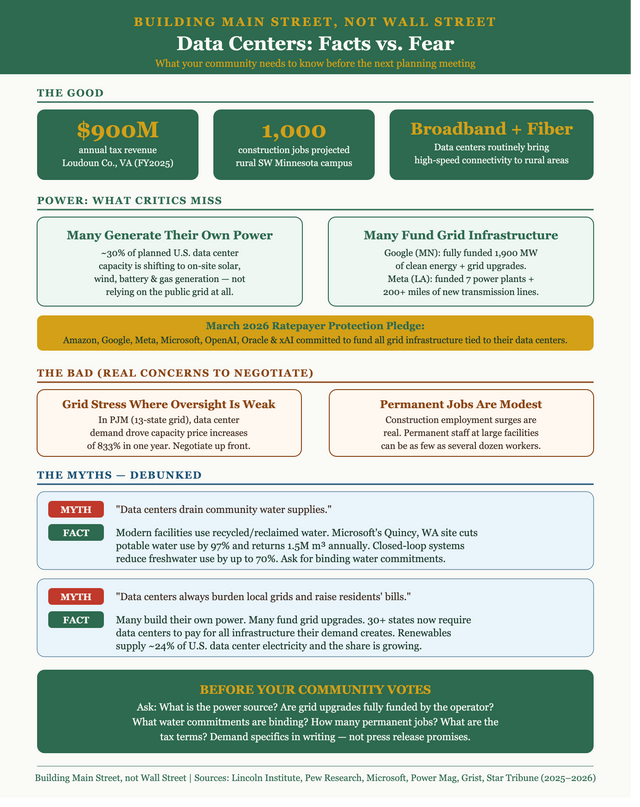
First, the good. Data centers represent multi-billion-dollar investments that bring jobs, tax revenue, and infrastructure upgrades to communities that have been waiting decades for that kind of attention. In Loudoun County, Virginia, property tax revenues from local data centers are expected to approach $900 million in fiscal year 2025, nearly matching the county's entire operating budget. In rural southwestern Minnesota, one proposed $4 billion campus is projected to generate roughly 1,000 construction jobs and tens of millions in annual local tax revenue. Beyond the dollars, data centers usually arrive with fiber infrastructure that benefits every resident and business nearby. For communities still fighting for reliable internet, that alone can be transformational.
Here is what critics rarely mention: a growing number of data centers generate their own power rather than drawing entirely from the public grid. About 30 percent of planned U.S. data center capacity is already shifting toward what the industry calls "bring your own power" strategies, with facilities building on-site solar, wind, battery storage, and natural gas generation. In Virginia, Vantage Data Centers has operated its own on-site power plant since September 2025 after being told the local utility could not connect them for years. Rather than burden the grid or wait out a bureaucratic backlog, they built their own solution.
And when data centers do connect to the grid, many are funding the upgrades themselves rather than passing costs to ratepayers. In Minnesota, Google signed a deal with Xcel Energy to fully fund 1,900 megawatts of new wind, solar, and battery storage, covering grid infrastructure costs as well. In Louisiana, Meta funded seven natural gas plants, more than 200 miles of transmission lines, and battery systems for regional infrastructure. In March 2026, seven major technology companies including Amazon, Google, Meta, and Microsoft signed a White House agreement committing to fund all necessary grid infrastructure improvements tied to their data centers.
Now, let’s be fair and discuss legitimate concerns. Grid stress is real where oversight is weak. In PJM, the grid operator covering 13 northeastern states, data center demand contributed to a capacity price increase of 833 percent between the 2024 and 2025 delivery years. Communities that fail to negotiate proper infrastructure agreements before a facility opens may find themselves absorbing costs they never agreed to carry. That is preventable. More than 30 states have now enacted or proposed large-load tariffs requiring data centers to pay for the grid infrastructure their demand creates, rather than spreading those costs to residential customers. Permanent staffing at large facilities can also be modest once construction crews leave, sometimes only several dozen full-time workers, and that should factor into any economic development agreement.
On water, critics are working from outdated information. Modern data centers increasingly use recycled and reclaimed water rather than potable freshwater. Microsoft built a system in Quincy, Washington that cuts potable water use by 97 percent and returns 1.5 million cubic meters annually for community drinking needs. Closed-loop cooling systems can reduce freshwater use by up to 70 percent compared to older evaporative methods. Communities should still ask exactly which source a facility plans to use and what recycling commitments will be binding. That is responsible engagement, not opposition.
The bottom line is this. When you swipe your debit card at Main Street's hardware store, a data center processes that transaction. When the local hospital retrieves a patient record, a data center makes that possible. When your child logs into school software, a data center is behind it. We are not debating whether to allow something foreign into our communities. We are deciding whether our communities will benefit from the expansion of something we already rely on every day.
Come informed. Ask about power sourcing, grid investment commitments, water recycling plans, permanent employment numbers, and tax agreements. Insist on binding language, not press release promises. Before your community's next data center vote, visit your state's economic development office to review published frameworks for negotiating large industrial agreements. The facts are on your side when you know them.
John A. Newby, a Chamber President, past Publisher & Media Executive, Business Owner, Consultant, and International Speaker is the author of the "Building Main Street, Not Wall Street" column dedicated to helping local communities combine their synergies allowing them to thrive in a world where truly-local is being lost to Wall Street interests. His email is [email protected]