Fresh Arrivals Make Communities Stronger
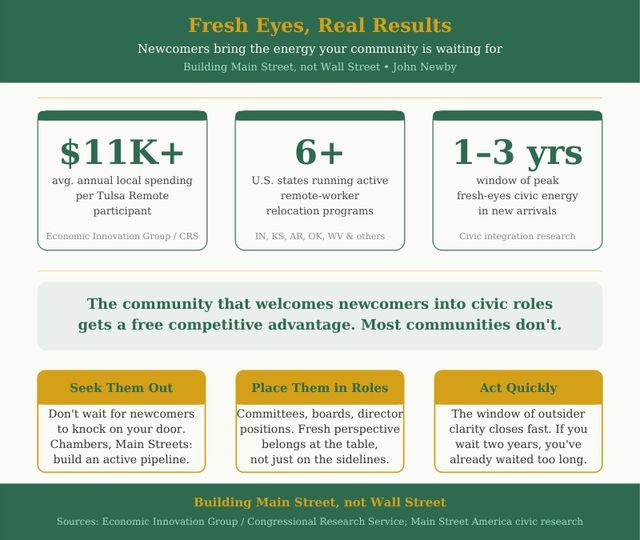
There is an old and antiquated saying in many small communities that goes something like this: "You haven't earned the right to have an opinion yet." It is usually not stated that bluntly, but the message gets delivered just the same, sometimes through a cold shoulder at a chamber meeting, sometimes through an eye roll when a new resident raises a hand at city council. As I have worked with many communities around the Country, I have seen this destructive attitude in community after community, and I will tell you plainly: that attitude is costing your community in a big way.
The truth is that the person who just moved to your town can be a valuable tool. Think about what it takes to deliberately choose a new community. People who relocate, whether across the country or just one county over, did not land there by accident. They evaluated options, weighed quality of life, considered their family's future, and made an intentional decision to locate to your community. That intentionality matters. When someone picks your town on purpose, they arrive with energy the longtime resident can no longer generate, not because they love the place any less, but because familiarity has a way of making the ordinary invisible.
A newcomer sees the broken sidewalk downtown. A newcomer notices that the coffee shop closes at two in the afternoon and wonders why. A newcomer asks why there is no weekend farmers market when the surrounding region has three. Those are not criticisms. Those are gifts. They are the observations that only fresh eyes can produce, and they are the seeds of every revitalization effort that has ever worked. The question is not whether to value those observations. The question is whether we are willing to put the people making them in a position to act on them.
Many of the most effective communities already understand this. They do not just tolerate newcomers in leadership roles. They recruit them specifically because of their outsider perspective. Consider how Main Street America programs across the country hire their local directors. Communities in Texas, Missouri, North Carolina, and dozens of other states regularly conduct national searches for Main Street directors rather than defaulting to a local hire. They do this because they know that someone who built revitalization results in another town can see possibilities in their community that a lifelong resident may not. I should add, when you get outsiders working with locals, the combined results can be dramatic.
That same logic applies to nonprofit leaders, economic development, chamber of commerce executives, and other organizations. Leadership and organizational development experts have noted that new leadership can bring a fresh perspective and critical missing voices that are imperative for the future success of an organization, and that relying solely on those already embedded in a single environment is often a losing strategy. Communities that act on that wisdom tend to move faster and farther than those that do not.
The same principle holds for everyday newcomers, not just professional hires. The Tulsa Remote program welcomed thousands of remote workers by pairing relocation grants with direct connections to volunteer opportunities, community organizations, and local businesses. An independent analysis by the Economic Innovation Group found the program generated nearly 600 new jobs in a single year, with projections showing it would add approximately $500 million in new earnings to the regional economy by 2025. Tulsa did not simply attract new bodies. It activated new citizens.
Dozens of communities across the country are now following the same playbook. States like Indiana, Kansas, Arkansas, and Oklahoma are offering relocation incentive packages that go well beyond a cash payment. The best programs include memberships to co-working spaces, introductions to small business networks, and access to local events, all deliberately designed to plug new arrivals into civic life from the moment they arrive. As one relocation research firm put it, newcomers contribute to civic life by volunteering, buying homes, and enrolling children in local schools. That is not a side effect. That is the strategy.
Here is what I want your community to take from all of this. Newcomers do not need a waiting period. They need an invitation. If your chamber, your Main Street program, your economic development office, or your city council is not actively identifying and placing new residents in leadership roles, you are leaving your best ideas in the parking lot. Set up a formal new resident welcoming process. Create a pathway from newcomer to committee member. Ask the person who just moved here what they see. Then, and this is the hard part, actually listen.
It need not always be a formal program, although that is good. Just ask your local community how you are currently welcoming and activating new residents in your community. The answer to that question may tell you more about your community's future than any strategic plan ever could.
John Newby, Pineville, MO., is a nationally recognized publisher, community, business and media consultant, & speaker. His column appears in communities nationwide. He is currently the CEO of the McDonald County Chamber and the founder of Truly-Local, dedicated to helping communities create excitement, energy, and capture the synergies needed to thrive in an ever increasingly complicated environment. He can be reached at [email protected].