Hope Is Not a Business or Community Strategy
Pooja Agnihotri said, "Fighting a change and clinging to the same old ways of doing things have never proved to be productive for anyone, you or your customers." I think about that line often, because I keep watching good people and good communities make the same mistake. They see change coming, and they hope it passes them by.
We have all known businesses that failed and communities that are in the process of failing. They had big dreams, a great work ethic and small budgets. They skipped the marketing line and hoped word of mouth would carry them. They hoped great customer service would set them apart. They hoped an affordable, out of the way location would still pull customers in. They hoped hard work and a good attitude would overcome every obstacle. In short, too many hopes, too little planning and not enough community support.
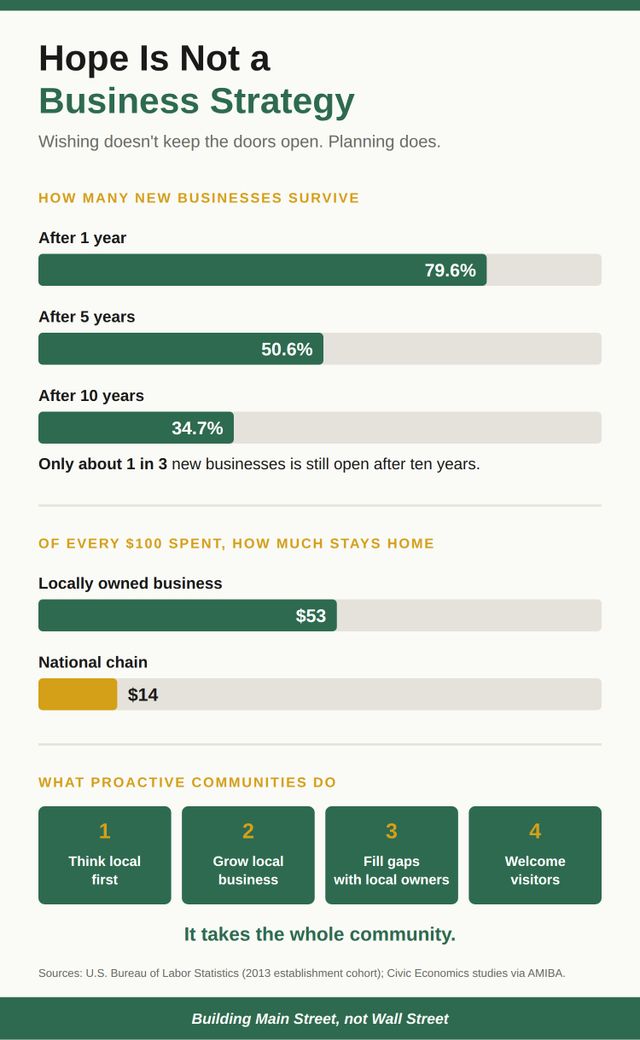
The numbers are sobering. Federal labor data shows roughly one in five new business establishments is gone within its first year. Only about half make it to year five, and barely a third are still open after ten years. Hope did not save the ones that closed. Most of them hoped plenty. The ones who last usually have something more than hope. They have a plan, a budget, a willingness to adjust and a community that has their back.
Communities fall into the very same trap. How many times have we heard, "Things will turn around," or "That's just the way we've always done it here"? Meanwhile shopping habits move online, young people move away, a big employer downsizes, and the storefronts on Main Street go dark one at a time. Wishing for the good old days is not a plan, it is a death wish. Waiting for a savior from outside is not a plan either. The communities that thrive decided long ago to get ahead of change instead of getting run over by it.
What does being proactive look like? First, build a truly local mindset from the top down. Forward thinking communities look inside their own borders before spending tax dollar elsewhere. That matters, because studies of local spending consistently find independent businesses recirculate far more of each dollar at home. One widely cited analysis found about 53 percent of a purchase at a local independent stay in the community, compared to under 14 percent at a chain.
Second, build networks that grow local businesses instead of waiting for a big one to arrive. We all want the large employer to come to town, but the math favors homegrown growth. Ten new businesses with five employees each, opened every year, equal a 250-employee company moving in every five years. Local owners need fewer tax breaks, and they are the ones who coach Little League, sponsor the county fair and sit on a chamber board.
Third, know your gaps and fill them with local entrepreneurs. Too often leaders court national chains to meet a need when a local restaurant owner or retailer could do it with a little push. Mentoring, small loan pools, shared marketing and a friendly permit office can turn a great idea into a business. Then celebrate owners loudly when they open their doors.
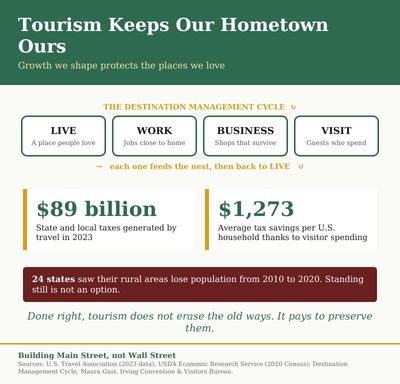
Fourth, think like a destination. I've said it before, treat every visitor as $1,000 walking into town ready to spend. A hundred visitors is $100,000. You don't need to be Branson or Chicago. Travelers want something unique, whether that is an event, a downtown or a shop they can't find anywhere else. Find your niche, build on it, and tell the world.
None of this happens because a small group of people wishes hard enough. Managing change is a community effort. The chamber can't do it alone. City hall can't do it alone. Business owners can't do it alone, and residents who never shop downtown can't expect downtown to survive. Every one of us has a role, whether that means spending locally, serving on a board, showing up at a council meeting or mentoring a new owner.
Pick one change you see coming to your community. Then call a local elected official or your chamber and ask what the plan is. If there isn't one, offer to help build it. And spend your next dollar at a locally owned business. Make no mistake, this is a high-stakes competition with winners and losers. Hope won't decide where your community lands. Action will!
John A. Newby, a Chamber CEO, Publisher & Media Executive, Business Owner, Consultant, and International Speaker is the author of the "Building Main Street, Not Wall Street" a column dedicated to helping local businesses & communities build stronger foundations allowing them to thrive in a world where local is lost to Wall Street interests. His email is [email protected]