Bet On Small Business, Not Big Boxes
Nearly four years ago I wrote about a study called "Where Our Jobs Come From." The author, Don Macke of the Center for Rural Entrepreneurship, laid out numbers every small or mid-sized community should know by heart. I want to revisit that argument today, because the newest data does not just confirm it. It makes the case even stronger.
Here is where we stood back then. Between 2006 and 2016, the country added 48 million net new jobs, and businesses with fewer than 100 employees accounted for 95 percent of them. Businesses with 500 or more workers actually lost jobs over that same stretch. That was already a striking picture of where opportunity really comes from.
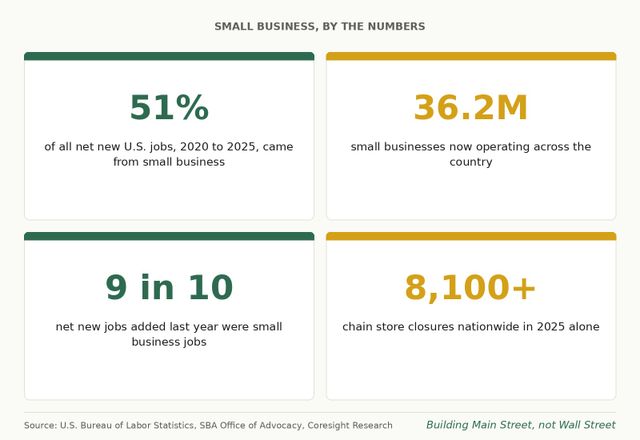
Now look at the recent or fresh numbers. The Bureau of Labor Statistics (BLS) reports that small firms, those under 250 employees, accounted for 51 percent of all net job creation between the third quarter of 2020 and the third quarter of 2025. The Small Business Administration's 2025 profile shows the country now has 36.2 million small businesses employing 62.3 million people, nearly 46 percent of the entire private workforce. And in the most recent year measured, small businesses were responsible for close to nine out of every ten net new jobs added nationwide. The Treasury Department found that since 2019, small businesses have generated more than 70 percent of all net new job growth in America.
Meanwhile the businesses that so many communities still chase, the big box stores and anchor chains, keep telling a different story. Retail trackers counted more than eight thousand store closures across the country last year alone. Familiar names disappeared entirely. Nearly three hundred shopping malls are projected to close by 2028, and vacancy in the weakest properties now tops thirteen percent. The glut I warned about a few years back has not slowed. It has accelerated.
So why do so many towns still spend their limited time and tax dollars courting one large employer instead of growing a hundred small ones? There are roughly ten thousand communities across this country competing for those same big prospects, and the odds of landing one and keeping it are somewhere between one and two percent. Communities that do land one are usually places that already had strong infrastructure and outstanding quality of life, which means the big employer was a reward for good decisions, not a substitute for them. Everyone else is placing a very expensive bet with very poor odds.
There is another shift happening underneath all of this, and it is moving faster than most local plans account for. Roughly seventy million Americans now do freelance, contract, or self-employed work, more than a third of the entire workforce, and researchers expect that share to keep climbing toward half the workforce within the next few years. That is not a fringe trend anymore. It is a preview of who your next generation of taxpayers, customers, and volunteers will be.
Picture your own downtown with a third of your working residents earning their living independently rather than clocking in at one employer. Would you still be subsidizing another half empty retail pad, or would you be investing in reliable broadband, flexible small office space, and shared work hubs where a bookkeeper, a web designer, and a craftsman could each rent a desk for what they actually need? Forward thinking communities are already asking these questions, and the ones asking now will be years ahead of the ones still waiting for a factory that may never come.
None of this means turning your back on the larger employers already rooted in your community. If you have one, treat it well. It adds real balance. But if you are still building your entire economic strategy around landing the next big one, the numbers are telling you, loudly and repeatedly, that the surer path runs through the businesses already on your Main Street and the entrepreneurs quietly starting new ones in spare bedrooms and garages this year.
America was not built by waiting for a single company to save a town. It was built by shopkeepers, tradespeople, and risk takers who bet on their own neighborhoods first. That is still true, and the data now proves it more clearly than ever.
Here is something you can do about it in the next day. Walk into one locally owned business you have been meaning to visit and make a purchase there, not online, before this week is out. Then tell the owner you are glad they are there. Small gestures like that, multiplied across a whole community, are exactly how small communities and Main Streets keeps winning.
John A. Newby, a Chamber CEO, Publisher & Media Executive, Business Owner, Consultant, and International Speaker is the author of the "Building Main Street, Not Wall Street" a column dedicated to helping local businesses & communities build stronger foundations allowing them to thrive in a world where local is lost to Wall Street interests. His email is [email protected]