Most owners never built a business
In 1972, a 24-year-old bass fisherman named Johnny Morris cleared out eight square feet of floor space in the back of his father's liquor store in Springfield, Missouri, and started selling fishing tackle. Eight square feet. Here is the part almost everybody forgets when they tell that story: that little corner stayed his only location for the next thirteen years before Bass Pro Shops went big.
I think about that every time an owner asks me why business is so hard. Not hard for a season, which is normal, but hard forever, in year one and still in year fifteen. The owners I meet who never stop struggling tend to have one thing in common. They did not really build a business. They just bought themselves a very demanding job.
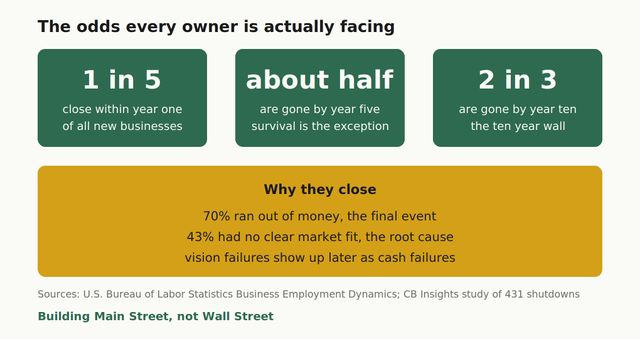
The numbers back up how common that is. Federal labor data shows about one in five new businesses close within twelve months, roughly half are gone by the five-year mark, and about two thirds have shut their doors within ten years. Those numbers usually get blamed on bad luck or a bad economy. They are neither.
Dig into the postmortems and the picture sharpens. One recent analysis of 431 companies that shut down found that running out of money showed up in seventy percent of the failures, but the researchers were blunt about it: an empty bank account is the last event, not the cause. The root problem, cited in forty three percent of cases, was that the owner never got clear on who they served and why it mattered enough to pay for. They ran out of cash because they ran out of reasons for anyone to walk through the door.
That is the real difference between the great owner and the average one. The average owner asks how to make it to the fifteenth of the month. The great owner asks what this business needs to look like in ten years and what has to get built right now so it is ready. One question keeps you alive. The other question builds something.
Look at what that second question produced in Ann Arbor, Michigan. Two partners opened a deli in 1982. Eleven years in, one of them asked the other where they wanted to be in ten years, and neither man had an answer. That embarrassment turned into a full year of arguing and long walks, and it ended with six written pages describing their business fifteen years into the future. They wrote that they would create a community of separate food businesses, each one unique, each one run by a managing partner with real ownership, and all of them within one town because they believed in doing business where you live. Roughly ninety percent of what they wrote came true. Today it is ten businesses, hundreds of employees, tens of millions in annual sales, and every last one of them still in Ann Arbor.
Now here is the caution, because dreaming big gets confused with growing fast, and they are opposites. Research on high growth companies found that around three quarters of them died from scaling before their foundation could carry the weight. Morris and Bass Pro ran one store for thirteen years while he learned the customer. The Ann Arbor partners decided at the outset they would never open a second deli, ever. Both dreamed enormous. Both built slow. The vision was the blueprint, not the bulldozer.
Every community I have worked with has both kinds of owner on the same block. One prices whatever the competitor prices, waits on walk in traffic, keeps the books in his head, trains nobody to replace him, and when his knees give out the lights go off and the street loses another storefront. The other one wrote down where he/she is going. They hire ahead of the need. They built customers who belong to the business and not just to her. When they step back, somebody is ready, and the building stays lit. Multiply either owner by forty storefronts and you have the entire future of a downtown and a community.
So here is your week. Take one hour, a pen, and a blank page, and write out what your business looks like ten years from today. Not goals. A picture. How many people work there, what you are known for, who runs it when you are gone. If you are not an owner, write the same page about your community. Then, within the next day, do two things. Spend money at a locally owned business and tell the owner why you keep coming back. And go to SBA.gov and find the free counseling or mentoring available in your area or send that link to somebody who is drowning right now.
Unwritten goals and plans are but a simple fantasy. Small dreams are not humble, they are just small. And they come true exactly as written.
John A. Newby, a Chamber CEO, Publisher & Media Executive, Business Owner, Consultant, and International Speaker is the author of the "Building Main Street, Not Wall Street" a column dedicated to helping local businesses & communities build stronger foundations allowing them to thrive in a world where local is lost to Wall Street interests. His email is [email protected]