Dream Big or Watch Your Town Fade!
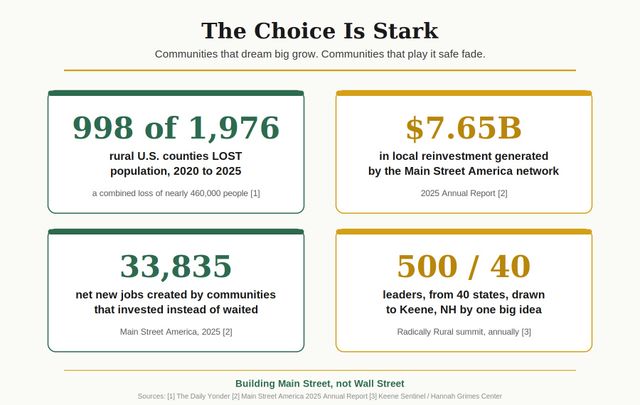
Nearly half of America's rural counties lost population between 2020 and 2025, a combined loss of almost 460,000 people. I have driven through hundreds of small and midsize towns over the years, and I can tell you which ones are shrinking before the census numbers ever confirm it. You can feel it in the empty storefronts and in leaders who talk about survival instead of growth.
This is not a slow drift. It is a choice. Every community sits at a fork in the road, and most of them quietly pick the path of least resistance. They settle for maintaining what they already have instead, living in the past or of building what they could have. That choice, repeated year after year, is what turns a town into a statistic.
A few years ago my wife and I returning from a business trip drove through Keene, New Hampshire, a small town tucked into the state's rolling hills. Keene refused to settle. The Keene Sentinel newspaper partnered with the Hannah Grimes Center for Entrepreneurship to build Radically Rural; a summit built entirely around the idea that small towns can produce extraordinary impact. That summit now pulls roughly five hundred people from forty states into Keene every single year. A newspaper and a nonprofit looked at their town and refused to accept small thinking. They built a stage for big ideas, and now the rest of the country shows up to stand on it.
Later on that same trip, we passed through Canton, Ohio, home of the Pro Football Hall of Fame. Ask yourself how a museum built around the National Football League ended up in Canton instead of one of the dozens of larger cities sitting closer to NFL teams. The answer is not luck. Canton's leaders wanted that Hall of Fame badly enough to chase it, and their local media stood beside them to promote it, sell it and refuse to let the dream quietly die. Today that decision brings tens of millions of dollars into Canton every year, money that would have landed somewhere else entirely if Canton's leaders had played it safe.
Here is the part communities do not want to hear. Thinking small and clinging to the past is not a neutral choice. It is a slow death sentence. The towns that settle for mild, safe successes are the same towns showing up in the population decline numbers a decade later. Meanwhile, communities that invested in their downtowns, growing tourism, building a future, instead of quietly managing decline are seeing real returns. The Main Street America network generated 7.65 billion dollars in local reinvestment and more than 23,000 net new jobs last year alone. Georgia's Main Street communities alone delivered 824 million dollars in economic impact in a single year. Dreaming big is not a nice extra sitting on top of good management. It is the only strategy that has ever actually worked.
Your community does not need a Pro Football Hall of Fame or a national conference to prove this point. What it needs is leaders, in your media, your chamber, your city & county halls, and your local businesses, who stop asking whether a big idea is realistic and start asking what it would take to make it real. Every excuse your town makes for staying small today is a reason someone will cite for its decline tomorrow. Communities do not fall behind overnight. They fall behind one safe, timid decision at a time; until one day the factory closes, young people leave, small businesses shrink, and nobody can explain exactly when it happened.
I am convinced the biggest obstacle facing most communities is not money. It is imagination. Leaders settle for mild successes on the road most traveled because it is safe and has few obstacles in the way. It is the leaders willing to travel the harder road, fully expecting obstacles, who end up winning the biggest prizes. Dreaming big does not guarantee you will win every time. It guarantees you will be tested; you will be sharpened and ready for the next big idea instead of standing still and watching your community die.
So here is what I am asking you to do, and I mean this week, not someday. Show up at your next city council or county commission meeting and ask one question out loud: what is the biggest idea this community has been too afraid to chase? If you cannot make the meeting, call your mayor or a commissioner today and ask that same question directly. Communities do not die because they lack resources. They die because nobody in the room was willing to dream bigger than their fear. Be the one who finally is. Your town's odds of winning depend on it.
John A. Newby, a Chamber CEO, Publisher & Media Executive, Business Owner, Consultant, and International Speaker is the author of the "Building Main Street, Not Wall Street" a column dedicated to helping local businesses & communities build stronger foundations allowing them to thrive in a world where local is lost to Wall Street interests. His email is [email protected]