Balance Is the Real Growth Strategy
Drive through almost any small town in America and you will see the same split screen. Many the storefronts on Main Street sit dark, and half the driveways on the edge of town are full of cars that leave before sunrise and come home after dark. Those are the two very different economies pulling at every small community I work with. One is quietly closing. The other has become a parking lot for a bigger city's workforce.
I hear the same three worries in nearly every county I visit. Young people leave for college and never come back. Families move in for cheap housing and commute an hour each way, spending their paychecks somewhere else. And the water, sewer, and broadband lines built for a much smaller town decades ago are now the reason a new employer looks elsewhere. Those problems feel separate. They are actually the same problem wearing three different hats.
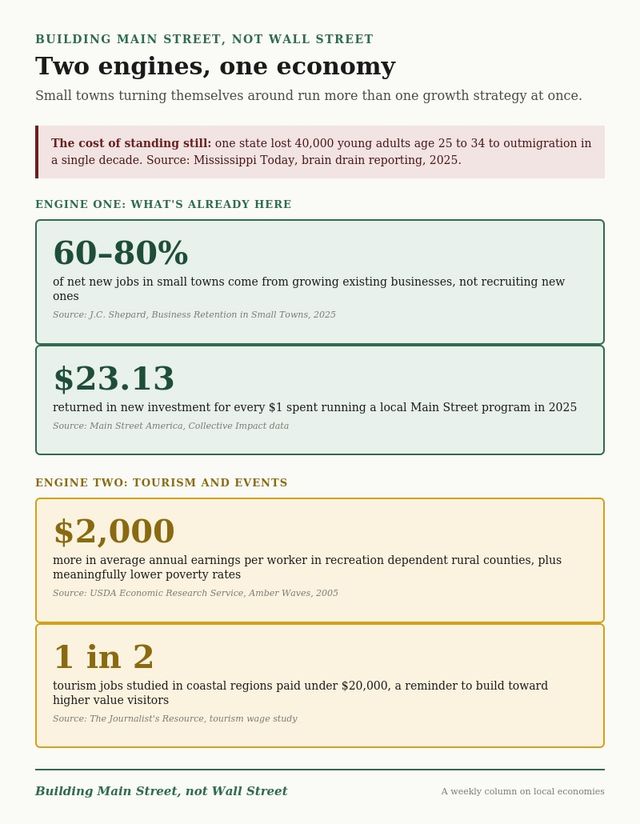
The numbers back up what you already feel. Researchers in Mississippi found the state lost roughly 40,000 residents ages 25 to 34 in a single decade, about a tenth of that age group, and nearly half of the state's four-year college graduates leave for good. Counties under 25,000 people lost population to outmigration at more than twice the national average over that same stretch. The graduates who leave are not chasing bright lights. On average they are chasing about $19,000 more a year in income, because their home state has jobs for only a quarter of its own college graduates. Young people are not abandoning small towns. They are following paychecks, and small towns have not been offering enough of them.
Infrastructure tells the same story from a different angle. In 1935, fewer than 11 percent of American farms had electricity, and closing that gap took deliberate public investment. Today the missing utility is broadband, and the pattern repeats. Communities with strong broadband adoption show measurably more economic dynamism than those without it, and local officials now say plainly that internet quality decides whether a town can grow at all. A bedroom community with no fiber and a failing lift station will keep exporting its workers and its tax dollars no matter how nice the town square looks.
None of this gets solved by picking one silver bullet. The towns turning themselves around run more than one engine at once, not one instead of the other. The first engine is the businesses and buildings already inside the city limits. Business retention and expansion, keeping the employers, you already have healthy and helping them grow, accounts for 60 to 80 percent of net new jobs in small towns. Main Street reinvestment backs that up nationally. Since 1980, local Main Street programs have generated $124.67 billion in local reinvestment and a net gain of more than 850,000 jobs, and in 2025 alone every dollar spent running a local program returned $23.13 in new investment. That engine runs on what your county already has.
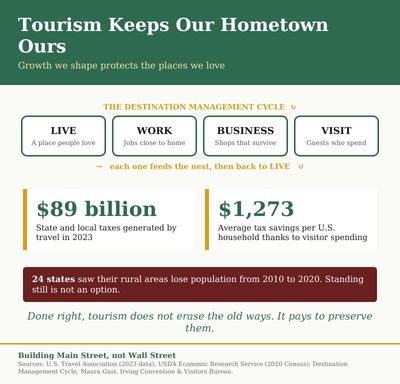
The second engine is tourism and events, and the data says it earns a real seat at the table, not a supporting role. Recreation dependent rural counties show genuine gains, with residents earning roughly $2,000 more per worker and meaningfully lower poverty rates than similar counties without a visitor economy throughout the Country. Events and outdoor recreation pull in dollars that never touch your county otherwise, they give commuters and empty nesters a reason to stay instead of just sleep there, and a good festival or trailhead can move faster than a multi-year infrastructure project. The catch is quality, not the strategy. In the coastal tourism economies researchers studied, half of tourism jobs paid under $20,000 a year. That is a reason to build toward higher value and income visitors and locally owned lodging, Airbnb’s and so forth, not a reason to skip tourism.
Here is what that means for your town. Do not wait for one strategy to finish before starting the next. Support the businesses already on your square while you build the trail system, the festival or events, or the river access that draws people in. Fix the broadband and the lift station while your tourism board runs its next campaign. A bedroom community, a college town, and a river town do not all need the same mix, but each need more than one engine running to stop exporting its own young people and its own tax dollars.
This week, do one thing about it. Walk into one locally owned business, or buy a ticket to one local event, you have never tried before. Multiplied across a county, that is the kind of reinvestment, on every front at once, that rebuilds a Main Street. Just as an example, in a community of 10K people, if each resident spent $100/mo. in their community than they might have spent outside their community each month, that is $1,000,000 each month or $12,000,000 per year circulating through your community. When you consider the compounding impact of those dollars, that number grows to $36,000,000. Think what that can do to enhance businesses and/or create new employment opportunities. That small effort can start to change a community in a huge way, and no one person or family bears that burden. Spend Local!
John A. Newby, a Chamber CEO, Publisher & Media Executive, Business Owner, Consultant, and International Speaker is the author of the "Building Main Street, Not Wall Street" a column dedicated to helping local businesses & communities build stronger foundations allowing them to thrive in a world where local is lost to Wall Street interests. His email is [email protected]