Tourism Keeps Our Hometown Ours
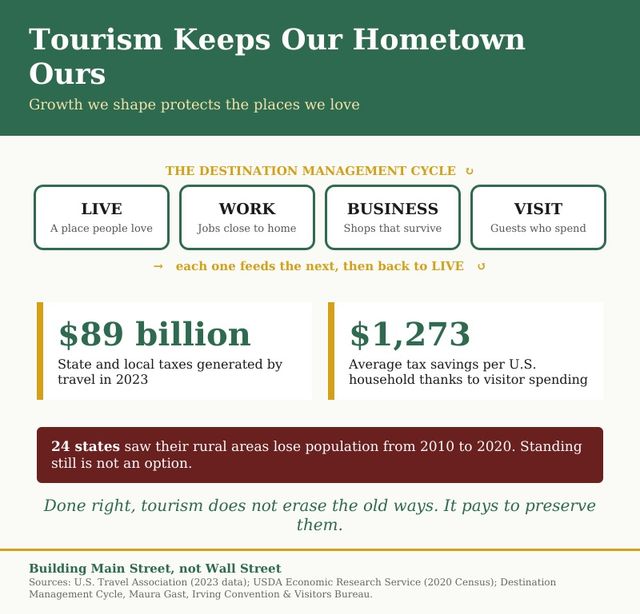
A few years ago, I came across this study which included this: “The Destination Management Cycle,” created by Maura Gast of the Irving, Texas Convention and Visitors Bureau. It states: “If you build a place where people want to live, you’ll build a place where people want to work. If you build a place where people want to work, you’ll build a place where business needs to be. If you build a place where business has to be, you’ll build a place where people must visit. If you build a place people want to visit, you build a place where people want to live.”
I love this because it describes a circle. There is no starting line and no finish line. A community either keeps that wheel turning or it slowly grinds to a halt. We have all driven through towns where it stopped. The storefronts sit empty, the school has consolidated, and the young people left for somewhere else and never came back.
I want to speak to those who love their hometown just the way it is. When some folks hear the word tourism, they picture traffic, strangers, higher prices, and outsiders telling us how to live. They worry the place they grew up will be traded away for something they no longer recognize. That concern comes from a good place. It comes from love.
Here is a hard truth. Standing still is not a viable option. A town is either growing or it is shrinking, and shrinking is not the same as staying the same. Shrinking means fewer customers at your retail store, fewer families in church pews, fewer volunteers at the fire department, and fewer reasons for our grandchildren to stay. In the last census decade, 24 states saw rural areas lose population. They are classmates, cousins, and neighbors who moved away chasing better opportunity.
In many places, change is already headed our way whether we invite it or not. Many rural communities are watching growth creep outward from a booming region just down the road. That growth can feel like a threat, others view it a chance and opportunity. The question is not whether change comes, that is the only certainty. The real question is whether we shape it with our own hands and our own values or let someone else shape it for us.
This is where tourism earns its keep. Visitors do not travel to see what they can find at home. They come for what is real and what is ours: the river, the history, the farm stands, the music and events, the Friday night ballgame, the stories the old timers tell. When managed correctly, tourism need not erase the old ways that are worth keeping. It pays to preserve them. It gives the historic building a reason to be restored, the hometown festival a reason to keep going, and the family diner enough customers to survive a slow winter.
Tourism can also lighten the financial load on those of us who live here. The taxes visitors leave behind help pave our roads and fund our services. Nationally, travel generated nearly $89 billion in state and local taxes in 2025, saving the average household about $1,273. That is money our neighbors did not have to pay because someone from somewhere else enjoyed a weekend with us. They spend their money and then go home.
Local businesses struggle to survive on residential spending alone. For many, visitors are the difference between operating in the red or the black. Every dollar a visitor spends at a locally owned shop gets spent again with the plumber, the mechanic, and the kid mowing lawns down the street. When that circle turns, everyone benefits, including those who never wanted visitors in the first place.
None of this requires us to become something we are not. Communities doing tourism best are those that know exactly who they are and refuse to apologize for it. They build around their character, not someone else’s blueprint. They welcome guests the same way we have always welcomed company on the front porch: with pride, a good meal, and an invitation to come back.
Those who already see the value need to make the case with patience, not frustration. Those who are skeptical deserve to be heard. Resistance is really a fear of loss, the best answer to that fear is showing people everything they stand to keep.
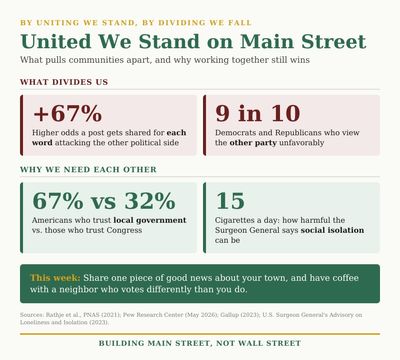
Here is a challenge, sit down with someone in your community who sees growth and tourism differently than you do. Buy them a cup of coffee and listen. Then share what you hope your town looks like for your grandchildren.
John A. Newby, a Chamber CEO, Publisher & Media Executive, Business Owner, Consultant & International Speaker is the author of the "Building Main Street, Not Wall Street" a column dedicated to helping local businesses & communities build stronger foundations allowing them to thrive in a world where local is lost to Wall Street interests. His email is [email protected]